
Boys Like Us
If you’re just joining us, in part one of this series, “The Crime that Had No Name” we covered the rise in sextortion cases and why we should be paying attention. This crime now effects roughly 1 in 7 self-reporting teenagers. With at least three dozen documented teen suicides tied directly to sextortion, talking about this growing crime openly and honestly with kids in age appropriate ways has measurable impact in reducing harm.
Of course statistics let us measure but they don’t tell us about the real people impacted. About the families driven to share their sons’ stories to educate communities and advocate for laws holding blackmailing criminals accountable. Nor do they help us understand what the research says is happening psychologically in the hours between first contact and tragedy. Let’s dive in.
The Victims and Families That Changed the Conversation

Picture of Jordan DeMay
On March 25, 2022 Jordan DeMay, 17, of Marquette, Michigan, dropped his girlfriend off at home before heading home himself. Jordan was captain of the football team, prom king, presenting as a healthy, everyday teen with friends, family, and support. All the trappings that lure parents into believing their kids are safer, buffered by a life well lived.
While at home, Jordan doomscrolled away on Instagram when fellow teen Dani Roberts sent flirty messages. Only Dani’s account had been hacked. Escalating rapidly, as teens do, within hours they’d sent each other explicit photos and the extortion started. In the hours that followed Jordan spun out over the threats to send the photos to his parents, girlfriend, coach, and friends if he didn’t send $1000. Jordan attempted to satisfy the debt with what money he’d saved from working and cobbling together other resources. But the scammers were relentless, ignoring Jordan’s pleas, stating he would end his own life. Tortured, spent, convinced his life was over, Jordan collapsed under the weight of the perceived shame.
In Jordan’s case, the FBI in conjunction with the US Attorney’s office and Nigerian authorities worked together to track the perpetrators in Nigeria. In one of the first cases of its kind, two men were extradited, tried, and found guilty. Both Samuel and Samson Ogoshi were sentenced to over 17 years each in federal prison as of September 2024. Jordan’s case was among the first where sextortion perpetrators faced consequences similar to homicide in a US court for a singular victim's death.
Since then, an additional five American males have been charged and plead guilty in connection to Jordan’s case. Over 100 additional individuals had been targeted and systematically tortured by these men.
Jordan’s parents Jenn Buta and John DeMay have spent countless hours advocating to end the stigma, hold criminals accountable, and impacting communities through education. John has also played a prominent role in targeting companies like Meta to handle teen accounts better, safeguarding them where predators lurk. Thank you to Jordan’s family for sharing his story and changing the landscape for teens globally through their advocacy.
Landen Weigelt, the 17-year-old from Oconto, Wisconsin, whose story opened part one, died by suicide in February 2023. His parents, Jamie and Jared Weigelt, have spent years telling his story to Wisconsin police departments and schools. It is one of the most difficult processes to turn grief into help. Jamie and Jared directly impact their community and all of ours who retell Landen’s story. Thank you to the Weigelt’s for educating adults to know and talk about the potential of sextortion while creating a truly safe space where kids can reach out with incredibly difficult situations before it's too late.
The last individual story we’ll cover today of the victims is James T. Woods, 17, of Alaska. James is the namesake of the proposed federal bill, The James T Woods Act / Stop Sextortion Act. His mother, Tamia Woods, testified before a Senate panel in December 2025, pushing for national action modeled after states like Wisconsin, Michigan, and Minnesota.
The bill is currently under congressional review to criminalize threats to distribute sensitive images of minors. The distinction to threats alleviates distribution or death as thresholds to appropriately hold these criminals accountable. This is important because in cases like the Delaware-Based Transnational Ring from September 2024 where the FBI indicted four men in Wilmington, DE, prosecution need not prove harm beyond threat, as the threat is the harm.
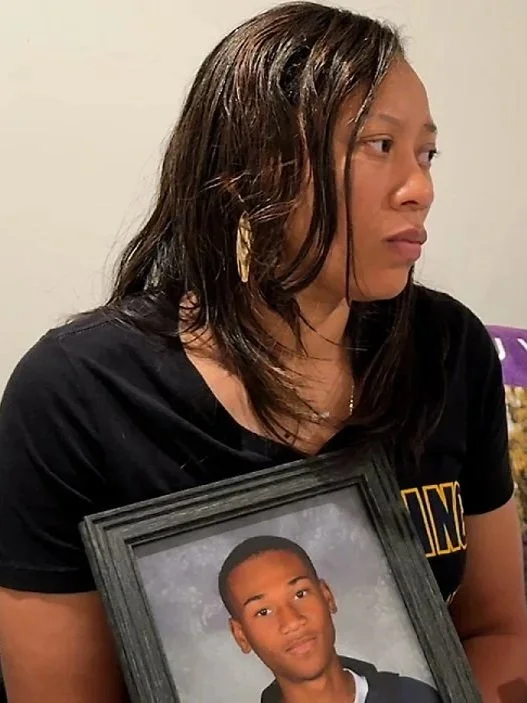
Tamia Woods holding a photo of her son, James
If you haven’t heard about the Delaware based crime ring, you’re not alone even though that’s right in the backyard of more than 75% of our readership right now. These disgusting humans targeted children as part of an international syndicate. Posing as young women online and recording thousands of victims in an international, financially motivated sextortion and money laundering scheme. Charges include cyberstalking, interstate threats, extortion, money laundering, and wire fraud. Using multiple payment systems they attempted to extort roughly $7 million from thousands of victims, succeeding in extorting roughly $2 million through CashApp and Apple Pay alone. While few states have taken action, the proposed bill would protect children nationwide making prosecuting cases like the Delaware ring much more feasible with appropriate laws backing the crime. Thank you, Ms. Woods, for championing this cause for all and to Senators Chuck Grassley and Dick Durbin for their backing.
More victims surfaced throughout the reporting on this crisis, Riley Basford, Ryan Last, each worthy of having their story told each with a nearly identical arc. Flirty fun turns to explicit images, threats, shame, and a window of hours to days in which a teenager a teenager was tortured into unbearable shame that led to a permanent way out. We say their names, comfort the grieving, and share knowledge to protect others. Shedding light on these victims’ stories is a definitive way to reduce harm.
These boys and their families are the tip of the iceberg. While more than three dozen suicides sounds low, especially in comparison to the vast number each year, it’s a number that can be eliminated, maybe before it grows. Because sextortion has an identifiable, singular, preventable cause with rapid escalation, openly discussing scenarios and strategies with teens before an incident absolutely slashes the potential for loss of life as an outcome.
What the Research Says
It would be nice if these were isolated tragedies with the publicity and advocacy around them also changing laws preventing more. The data says otherwise.
A 2026 study published in Child Abuse & Neglect surveyed about 3,500 US middle and high schoolers showed a statistically significant relationship between experiencing sextortion and suicidal thoughts and behaviors. These findings aren’t click-bait correlation, but rigorous findings based on multiple factors with rigorous controls for other factors.
A few details from that research are worth sitting with, so I’ll repeat them. Teen boys are the most targeted group with 19.4% of boys reporting exposure compared to 9.9% of girls. This is a shift from older patterns of image based abuse which more often centered on girls and women. The shift lines up with the financially motivated model where criminals specifically target boys who they believe are more likely to have access to money and less likely to tell an adult out of shame. It’s that second part that we really need to hear.

Stigma in all things, including character, mental health, letting parents down, all of that and more, remain the biggest barriers between teens coming to parents or trusted adults for help. No matter the relationship you have with your child. No matter how close you are with your players as a coach. Even with a history of telling you everything. In fact, an excellent relationship without exposure to handling difficult or dangerous situations without shame, can increase the likelihood of harm because you are the last person they want to let down.
One factor that stood out in the research to me is that it didn't matter whether the perpetrator was a stranger or someone the victim knew. Researchers also expected betrayal from a friend or partner would be more psychologically damaging than being targeted by a total stranger. But it wasn't. Suicide risk was equally elevated either way. In other words, the threat of exposure itself does the damage, not who the person making the threats is, because the relationships that would suffer from exposure threat are the ones that matter to the child.
Researchers have made rapid progress, pointing to a specific set of compounding factors that make sextortion uniquely dangerous compared to other forms of online harm.
First, speed. Unlike bullying or harassment that unfolds over weeks, sextortion moves from first contact to explicit threat within hours leaving no time for a teenager to process what's happening.
Then, shame as a weapon. Criminals cultivate silence by leaning on guilt, embarrassment, and fear of reaction. Victims studies describe feelings of self conscious emotions like shame, guilt, and humiliation as the reason why they didn’t seek help. Stigma is THE weapon.
Add in fear of the law. In bitter irony, some teenagers who send explicit images of themselves have technically created what the law would define as child sexual abuse material (CSAM). Some victims fear they'll be prosecuted, not protected, if they come forward. While this is changing, not all states have clarified that sextortion victims won't be charged for images sent under coercion.
Last, there’s no sense of an out. Should victims be able to meet initial demands like making a payment, demands almost always increase rather than stop. From spinning out, to relief, only to be targeted again leaves victims feeling like there's no way out. No way to make it stop without their picture, and their shame, in the hands of people they care about.
But there’s still a piece missing. Everything shared today, the victims, families, laws, studies etc exist because minors are, correctly, treated as a protected class. This protection triggers automatic reporting requirements, dedicated federal task forces, and the nonprofit NCMEC whose entire mission is tracking crimes against children. That infrastructure doesn't exist for adults. And what little research is available suggests it probably should. Join us next week where we’ll step into part three, The Missing Data, Sextortion After 25.

Thank you for reading and for helping end the stigma around suicide and mental health. Stigma continues to be the #1 blocker that keeps people from getting help. As always, reach out and speak up. The life you save might be your own.
If you’d like to support our work to end the stigma, all stigma, associated with mental health, like this post and follow our page. You can also make a one time or monthly donation to continue funding programs that directly empower children with coping skills and self advocacy for a life well lived.
Until next time,
Jen